

Update on Oct, 28th 2026: Added SOC 2 Type 2 and HIPPA compliance, which was missing in the original article. Check out more on https://www.meibel.ai/
Whenever I attend an AI conference, I am struck by how many vendors I have never heard of.
Beyond the familiar names and headline sponsors, there are dozens—sometimes hundreds—of companies promising to solve a particular piece of the enterprise AI puzzle. Some offer little more than familiar technology in new packaging. Others may be genuinely interesting. From a conference booth or a polished demo, it is almost impossible to tell which is which.
That makes me curious. What do these companies actually offer? Where would their technology fit within an enterprise architecture? What distinguishes it from the alternatives? Is there real substance behind the positioning—and, occasionally, a hidden gem worth watching?
I want to go beyond the marketing page and the five-minute demo. Not necessarily because I intend to use or recommend a product, but because I want to understand what it actually does, where it fits, what makes it different, where its limitations lie, and whether it belongs on an enterprise technology radar.
That is the idea behind a new ETX2 asset series: Technology Dossiers.
What is an ETX2 Technology Dossier?
ETX2 Technology Dossiers are compact but detailed assessments for people who need to look beyond product positioning.
There is no fixed publishing roadmap and no attempt to cover the market systematically. I will investigate technologies that cross my path through projects, research, conferences, or conversations—or simply because something looks interesting enough to examine more closely.
The dossiers may cover startups, established vendors, individual products, platforms, or particular technology approaches.
Importantly, there is no financial relationship behind the selection. I am not paid by the vendors, there is no affiliate model, and inclusion in a dossier does not constitute a recommendation.
The purpose is to investigate, assess, and document what I find.
Each dossier will typically examine:
what the product is—and what it is not,
company and product maturity,
architecture and technical capabilities,
distinctive features,
deployment and integration options,
suitability for enterprise and regulated environments,
customer references and available evidence,
limitations and open questions,
and practical considerations for evaluating the technology.
Where possible, I will also include hands-on observations.
These are not laboratory benchmarks or formal procurement assessments. Think of them as independent technology reconnaissance for enterprise practitioners.
Dossier #1: Meibel AI
The first dossier examines Meibel, a relatively young AI company I encountered while researching document-centric enterprise AI.
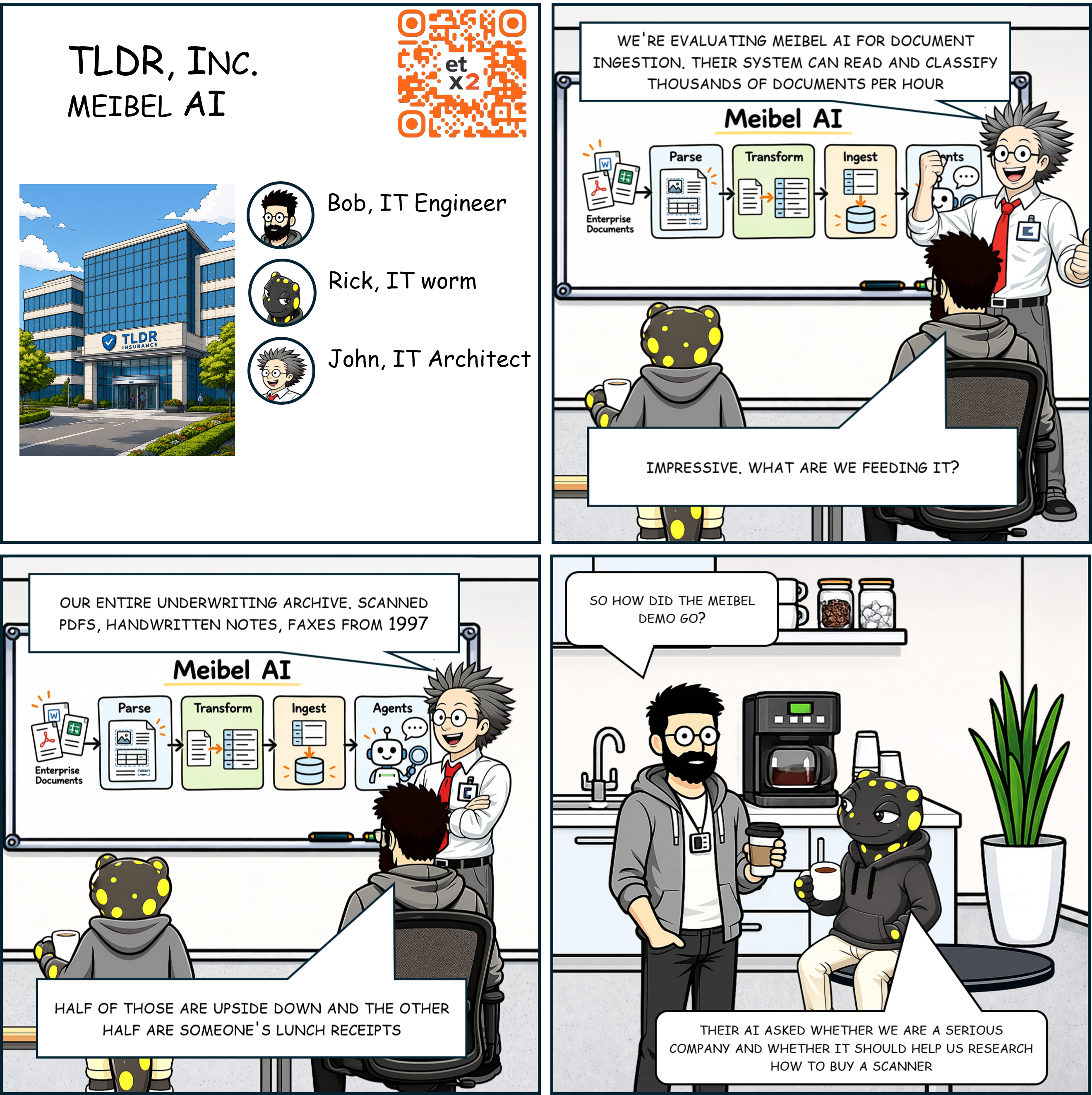
Meibel positions its platform between complex enterprise documents and the AI applications or agents that need to work with them.
At a high level, its architecture follows a four-stage pipeline:
Parse → Transform → Ingest → Agents
Documents are decomposed and interpreted, transformed into structured schemas, indexed for different retrieval mechanisms, and made available to AI agents. Confidence scoring, provenance, and execution policies operate across those stages.
That makes Meibel more than a conventional OCR or document-extraction service.
Three aspects caught my attention in particular.
1. Runtime confidence—not just AI output
Meibel places unusual emphasis on measuring confidence throughout the processing pipeline.
Confidence is not merely displayed as metadata. It can help determine whether an AI-generated result proceeds automatically, is processed again, is sent to a human reviewer, or is rejected.
For enterprise AI, I find this particularly interesting.
The relevant question is increasingly not “Can the model produce an answer?” but:
“Under what conditions am I prepared to let software act on that answer?”
Those are very different questions.
2. Complex documents—not just clean text
The second interesting area is Meibel’s approach to document intelligence.
Instead of immediately flattening a document into chunks of text, the platform attempts to preserve structures such as tables, sections, figures, captions, footnotes, and cross-references. It can then expose structured information through schemas alongside semantic retrieval.
That matters because many of the most valuable enterprise documents are precisely those that conventional RAG pipelines struggle with: specifications, contracts, insurance documents, construction documents, RFPs, and other material in which layout and relationships carry meaning.
In my own limited testing, schema-based extraction through the API performed considerably better than simply uploading a difficult document through the user interface. I also found the document Q&A capability convincing, although repeated processing produced some non-deterministic behaviour that would merit closer investigation before production use.
3. Graphs enter the retrieval layer
The third area is one I find especially interesting: Meibel combines semantic retrieval and SQL-style access with graph-based traversal of relationships between document elements and references.
An enterprise question may require more than retrieving two individually relevant chunks. A system may also need to understand that one section constrains another, that a footnote qualifies a table entry, or that one document refers to a requirement defined elsewhere.
This moves the discussion beyond the simplistic idea that better RAG is mainly a matter of embedding models and chunk sizes.
How I tested Meibel
Meibel is an API-first product, so I wanted to evaluate it through code rather than rely solely on the user interface. I created a set of test scripts that submitted different document types, defined information to be extracted, and examined the resulting structured output. For the most demanding test, I used a deliberately complex sample insurance bordereau containing dense tables, irregular structures, and domain-specific information—the kind of document that quickly exposes the limitations of conventional extraction approaches.
I also built a small test application that allowed users to upload a document and specify arbitrary information they wanted to extract, rather than working with a single predefined schema. This was not intended as a formal benchmark, but as a practical exploration of how Meibel behaves when confronted with realistic enterprise documents and changing information requirements. The observations in this dossier therefore combine documentation research with limited hands-on testing of the platform’s APIs.
Interesting technology, early-stage vendor
This dossier is deliberately not an endorsement.
Meibel was founded in 2024 and remains a comparatively small company. Its publicly visible customer base is limited, large-scale independent benchmarks are absent, detailed enterprise pricing is not publicly documented. Meibel is SOC 2 Type 2 and HIPPA compliant, accoring to information the company shared with me.
For a regulated enterprise, those questions matter just as much as the technical architecture.
On the other hand, deployment options including SaaS, bring your own cloud, and on-premises make the platform more interesting for environments in which data sovereignty matters.
My current assessment is therefore fairly simple:
Meibel is not a technology I would standardize on without substantial further evaluation. But it belongs on the evaluation list when complex documents, provenance, and confidence-controlled AI automation are central to the problem.
Get the full Technology Dossier
The full ETX2 Technology Dossier: Meibel AI goes considerably deeper.
It covers the company, product architecture, customer references, document intelligence, confidence scoring, graph-based retrieval, enterprise deployment, security considerations, competitive positioning, and a suggested evaluation approach.
The dossier draws on public documentation, analyst and press coverage, material published by Meibel, customer references, and my limited hands-on testing. It has not undergone exhaustive validation, and its conclusions should be independently verified before any procurement or architecture decision.
Comment under the article or on LinkedIn when you are interested and I will send you the assessment.
That is also the philosophy behind the series: take an unfamiliar or interesting technology apart, document what I find, and share the result with people facing similar questions.
No rankings. No sponsored placements. No claim to cover the entire market.
Just a closer look beyond the AI conference headliners—and perhaps the occasional hidden gem.
Find out more about Meibel AI on their website: https://www.meibel.ai/
ETX2 Technology Dossier #1 — Meibel AI