

AI investment is growing rapidly. Pilots are everywhere. Agents are becoming the default answer to almost every enterprise technology question.
And yet there is an increasingly awkward question hanging over all of this activity:
Where is the ROI?
At Ai4 in Las Vegas, I attended two sessions that addressed exactly this problem.
The first was Guru Bhat’s “The ROI Illusion: Why Most Enterprise AI Isn’t Paying Off.” His argument was that enterprises often start AI transformation at the wrong level: with models and isolated use cases rather than the business workflow.
A few hours later, Sai Maddineni approached the same problem from an insurance perspective in “Insurance Industry’s AI Value Problem: The Reality of Unit Economics, Reliability and Auditability.” His question was more fundamental: just because AI can perform a task, does that mean AI should perform it?
Together, the two perspectives form a useful framework: understand the workflow first, then decide where AI actually belongs.
Stop starting with the AI use case
Bhat’s central argument was simple:
Don’t start with the use case. Start with the workflow.
Enterprises typically create lists of AI opportunities, rank them according to value and feasibility, and launch pilots. But a business workflow may contain many individual tasks and several potential AI use cases. Optimizing one convenient task does not necessarily improve the outcome of the workflow as a whole.
Think about underwriting. Document ingestion, data extraction, risk analysis, pricing, referrals, approvals and customer communication may all belong to the same workflow. Automating document summarization may save time, but that does not automatically mean the underwriting process becomes materially better.
The more useful starting point is:
What business outcome are we trying to change in this workflow?
Only then should we identify the places where AI can contribute.
ROI has to be designed in
Bhat also challenged the way enterprises measure AI success.
Number of users. Number of pilots. Number of tokens consumed. These may be useful activity metrics, but they are not ROI.
He proposed moving from adoption to proficiency — whether AI actually changes the speed or effectiveness of work — and finally to financial outcomes. He also argued that AI value is broader than conventional efficiency measures and can include work velocity, revenue uplift, risk and compliance.
This means the baseline and the expected outcome need to be defined before the solution is built.
Ten thousand employees using an AI assistant is an impressive adoption figure.
It is not yet a business case.
The economics also extend to the technology itself. Bhat questioned whether frontier models should be used for every task. Different activities may justify different models, costs and levels of intelligence, which points toward an orchestration layer capable of selecting the appropriate model and grounding it in enterprise data.
For agentic systems, he went further and emphasized knowledge graphs as a way to give agents the relationships and enterprise context needed to act on grounded information rather than isolated pieces of data.
So architecture itself becomes part of the ROI equation.
Just because AI can do it doesn’t mean it should
Maddineni attacked the problem from a different direction.
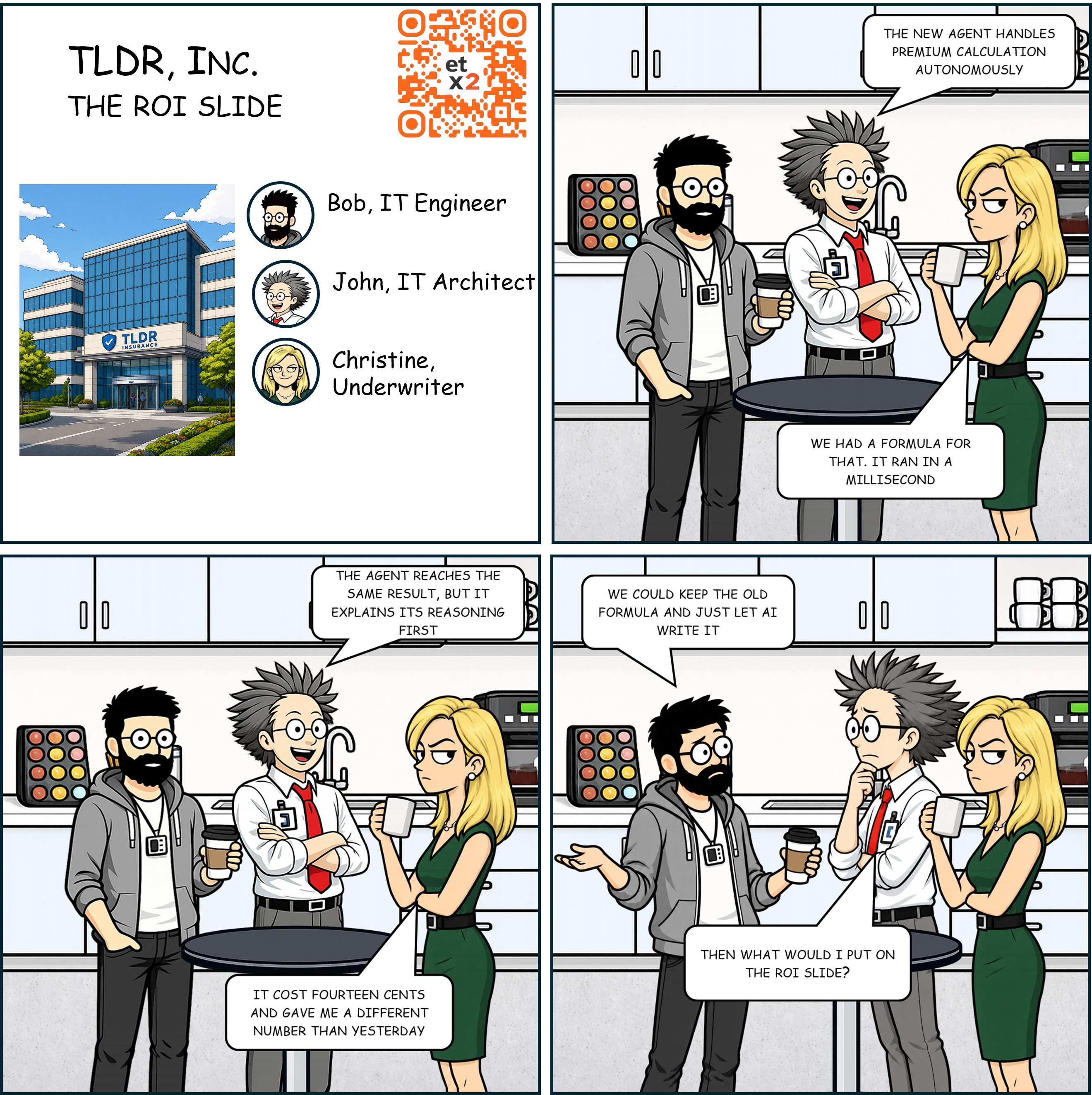
He opened with a deliberately trivial experiment: asking leading AI models to perform a simple calculation and comparing their cost with a small traditional Java program doing the same thing.
Both produced the answer. But according to his experiment, the AI approach was dramatically more expensive.
His point was not about arithmetic. It was about using the right technology for the right kind of work.
Insurance companies execute huge volumes of deterministic activities: eligibility rules, coverage checks, calculations, validations and other tasks where identical input should produce identical output.
An AI agent can perform many of these activities.
But why should it?
Technical capability is not the same as economic suitability.
Insurance contains different kinds of work
Maddineni described work as a spectrum.
At one end are deterministic, rules-based activities. At the other are activities that depend heavily on judgement, interpretation, experience and relationships.
A large part of insurance work is quantifiable and rule-driven. Yet much of it has never been fully automated, not because traditional software cannot execute the rules, but because the information surrounding them often arrives in difficult forms: PDFs, spreadsheets, emails and non-standard documents. Humans have effectively acted as the integration layer between structured systems and an unstructured world.
Generative AI changes this dramatically.
But that doesn’t necessarily mean the entire process should become generative AI.
For deterministic, high-volume activity, traditional software still has major advantages: predictable execution, reliability, auditability and low marginal cost. Maddineni therefore suggested an interesting alternative:
Use AI to build the software rather than using AI to be the software.
AI-assisted development can dramatically reduce implementation effort while allowing developers to review the resulting code, QA teams to test it and enterprises to operate deterministic software at scale.
Sometimes the best AI solution may therefore result in a production system where no LLM is involved in the actual transaction.
Where generative AI really fits
The picture changes when the work itself is cognitive and unstructured.
Maddineni used underwriting as an example. An underwriter may receive a large broker submission containing PDFs, financial data, schedules and correspondence. Simply understanding and structuring the submission may take significant time.
AI can summarize, extract and contextualize that material in seconds, allowing the underwriter either to handle more submissions or to spend more time on risk analysis and pricing.
And then there is a third category: work where humans should remain central.
When somebody has just lost a home in a catastrophe, the conversation with the insurer is not merely another process step. Empathy, reassurance and trust are part of the service itself. Maddineni argued that these human relationships should not disappear simply because an agent could technically handle the interaction.
That leads to a much more useful transformation question than “Where can we deploy an agent?”
For each activity, ask:
Should this be conventional software? Should AI augment it? Or should a human continue doing it?
Decompose first, automate second
This is where the two sessions converge.
Bhat says: start with the workflow, not the use case.
Maddineni says: break that workflow into individual activities and decide what belongs with software, AI or humans.
His recommendation was refreshingly practical: take an important, high-volume process, bring in the people who actually perform the work, understand its inputs and outputs, and decompose it into its individual parts.
From there, the architecture becomes much clearer:
Deterministic and high-volume: conventional software, increasingly built with AI assistance.
Cognitive and unstructured: generative AI, often augmenting human expertise.
Judgement, empathy and relationships: keep humans at the center.
Across all three, Bhat’s question still applies:
What measurable business outcome does changing this workflow create?
The real AI ROI illusion
Perhaps the AI ROI problem is therefore not primarily an AI problem.
It is a transformation problem.
Enterprises often start with technology, search for use cases, launch pilots and measure adoption. Only later do they ask whether the economics work.
Both sessions suggested reversing that logic.
Understand the workflow. Establish the baseline. Define the business outcome. Decompose the work. Decide where deterministic software, probabilistic AI and human judgement each belong. Then measure whether the redesigned workflow actually performs better.
And don’t restrict “better” to cost reduction.
Maddineni closed by arguing that freeing underwriters, actuaries and other specialists from administrative work can create space for better risk analysis, new products and competitive differentiation.
That may be the most useful way to think about AI ROI:
The winners will probably not be the companies deploying the most AI. They will be the companies that understand their business deeply enough to know exactly where AI creates value — and where it doesn’t.